 Skip to content

We’d like to share an article by UMDIS consultant Omar Waseem Haqqi, who brings over 25 years of international experience in mushroom cultivation and agri-food innovation. Omar has worked across Europe, the Middle East, and Asia, helping farms optimize production under diverse climate conditions. His insights offer valuable guidance for growers looking to improve efficiency and adapt to global challenges in mushroom farming.
Ever wondered why some composts come alive with microbial activity while others just won’t take off?
Often, the secret isn’t in the formula — it’s in the straw you start with.
In a perfect world, we compost makers would always have the straw that gives consistent results and forgives us when we slip (and yes, we all do).
That straw is wheat — reliable, forgiving, and productive.
But many of us don’t have that luxury. Across Asia and other warm regions, we work with what’s available: paddy (rice) straw — a tougher, trickier material that demands extra understanding.
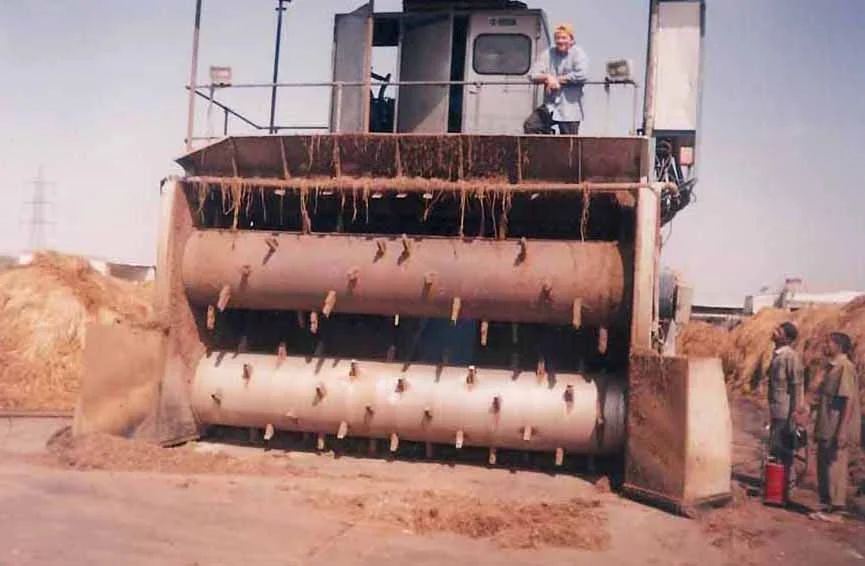
My Story with Paddy
It was the summer of 2007 in Hyderabad, India — the start of the monsoon season and, for me, a defining moment in warm-weather composting.
I had worked with paddy before — once at the same farm seven years earlier with great results, and again in Kolkata.
But this time, the challenge was bigger.
Reach European-level production on paddy straw — 24 kg/m² on the first flush (about 27 kg in Phase 3). No small feat under tropical conditions. After assessing the compost yard, I knew what I was dealing with.
Wheat straw has a stable, tubular structure that allows airflow; paddy is flat and dense, holding water and risking anaerobic spots. I’d seen this before and knew one mistake could cost the crop.
Paddy is also hard to run through mechanical turners when fresh because of its length and flexibility.
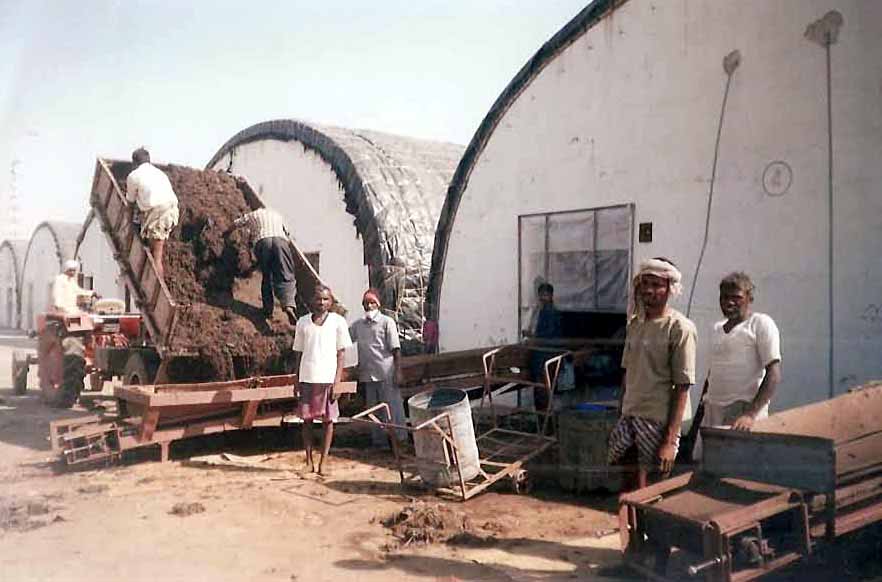
So I set a precise plan:
The Result
From the start of spawn run, I could tell it was different — the smell, the feel, the texture.
When the first flush came in, I waited before celebrating. But the numbers said it all.
– 24 kg per square meter — clean, even, and strong.
That moment proved what I had long believed:
👉 Paddy straw can perform just as well as wheat straw — if handled right.
👉 Warm-weather composting isn’t a limitation; it’s a discipline.
Key Takeaways
Pre-wet properly: Dewax fast and reach 55 °C early.
Improve aeration: Mix 20–40 % wheat straw or coarse fiber if possible.
Add slightly more gypsum: Reduces greasiness and stickiness.
Manage moisture precisely: Around 69 %, rarely higher.
Extend Phase II: 4–6 extra hours of pasteurisation for full conditioning.
Final Thoughts
In warm and tropical climates, both wheat and paddy straw can produce top-quality compost — but paddy needs tighter control of moisture, aeration, and timing.
Use thermophilic microbial inoculants when possible and respect its slower rhythm.
With patience and precision, paddy straw can rival — and even surprise — wheat straw.
Because great compost doesn’t depend on the raw material, it depends on the hands and mind that shape it.
