 Skip to content

“Use nematodes in every room and every cycle to get up to 80–90% control against Sciarids larvae. Do not skip a room!” says Ulrich, e-nema
e-nema’s biological pest control products are mostly based on entomopathogenic nematodes (EPNs). In mushroom cultivation, certain predatory only target pests like Sciarids, Phorids, and Cecids, but are completely safe for people, animals, and the mushrooms themselves.
In mushroom farming, flies are more than just a nuisance. Their larvae can do serious damage to mushroom mycelium and the mushrooms themselves. But when growers use nematodes consistently, in every growing room and in every cycle, they can stop up to 80–90% of Sciarid larvae before they become a problem. Even the more challenging to control Phorids can be kept under control with 40–50% effectiveness. That’s enough to avoid outbreaks during the hot summer months and avoid annoying your pickers and your neighbors.
Nematodes from e-nema aren’t just for mushrooms. They’re used in greenhouses, plant nurseries, soft fruit farms, parks, sports turf, and even home gardens.
So how are these nematodes made? There are different ways of producing EPNs, including liquid fermentation, solid fermentation or in insects (in vivo).
e-nema is the largest company in the world using liquid fermentation.
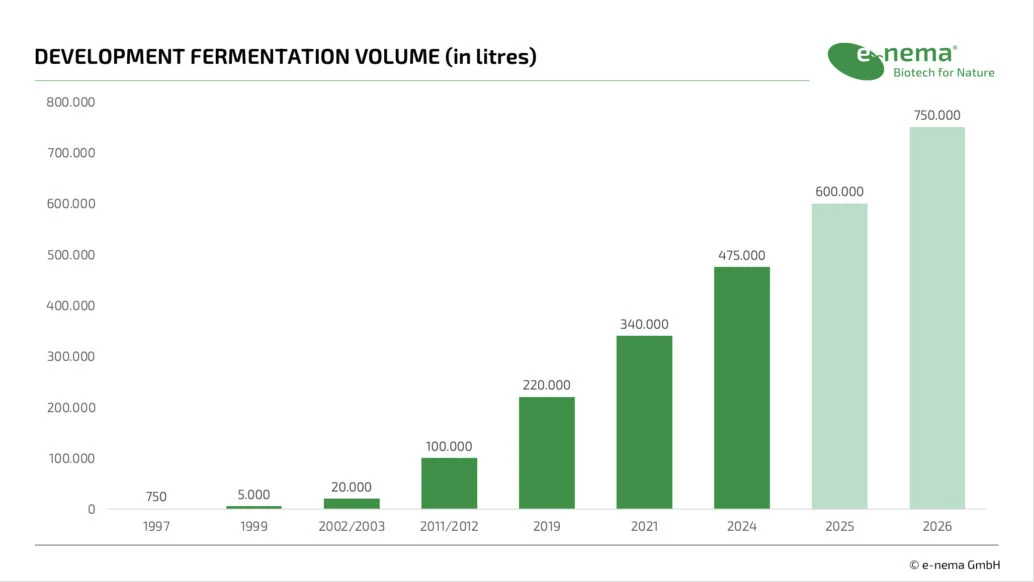
The below graph shows the development of e-nema’s fermentation capacity for 25 years:
Many countries are moving towards sustainable and environmentally friendly agricultural practices. We see Europe in front of this development. In the last 10 years, Europe banned almost all chemical crop protection methods, including insecticides. The USA are approx. 15 years behind, but Canada is even more strict than Europe. Consumers don’t want pesticides in the soil, water, or food chain. Retailers are demanding cleaner, safer food. Consumers don’t want pesticides in the soil, water, or food chain.
And even in countries where chemicals are still allowed, nematodes products are used in conventional growing. Within the life cycle of an insect there are stages, often in the soil, that cannot easily be controlled by chemicals. The best example are vine weevils where nematodes control the larvae and chemicals the adults. Nematodes handle that.
However, producing nematodes isn’t easy. It requires high-quality live production, careful conditions, and strict control , so yes, it costs more than spraying chemicals. But chemicals come with their own risks: resistance builds up, effectiveness drops, and they do not spare beneficial organisms.
e-nema started back in 1997 as a university start-up in Kiel, Germany. Today, it’s still a family-owned business with around 100 staff. Their mission? To reduce global pesticide use by offering smart, sustainable alternatives that really work.
Would you like to learn more about e-nema and their natural pest control products? Join the UMDIS Commercial Growing and Harvesting Courses in July 2025. You will get presentations on their products and how to you can use them for your needs. e-nema are official supporters of the courses. Contact us on Facebook to reserve your place.


